Tuesday, September 14, 2010

Yen All-Time High: Profit With FXY ETF Straddles

As we reported previously, the Yen hit a new 60-year high earlier today. The Bank of Japan is likely to come our swinging at this. Normally when interest rates rise a currency rises. Hint: they won't lower rates, at least not more than 0.10%!

However, they might engage in massive purchases of USDs or some other similar tactic.

Whether the Yen goes higher or lower, here are straddles for September and October:


These are computed with StraddlesCalc Tool, whihc shows that a move of about 1% is all that is needed for the position to become profitable in September, or 3% for October - as long as the stock moves.

This is not advice. Options are very dangerous and may cause 100% loss.

Stumble Upon Toolbar

Cisco Capitulates and Starts Dividends: No Longer A Growth Company

Cisco announced today that it will start paying a 1% dividend, similar to what MSFT (Microsoft) did a while back.


These big companies have finally realized that they are no longer the growing teenagers, but rather old adults, and n longer capable of growth spurts.


CSCO jumped 3% on the news as investors rejoiced. However, investors should realize that 1% is very little, and what it really means that they pay dividends, particularly i such a challenging economic climate.

CSCO (click for buy/sell alerts) stock has gone nowhere for quite some time and is down about 22% from its highs.

Stumble Upon Toolbar

Gold Soars and Canadian Miners ETF Hits All-Time High

QEII must be around the corner. Gold is soaring, and so are the Canadian miners. XGD.to has just hit a new all-time high:


Note: You may receive technical analysis and alerts of these stocks, sent automatically to you, by entering the symbols in the Technical Trend Analysis Tool, (powered by INO).

Stumble Upon Toolbar

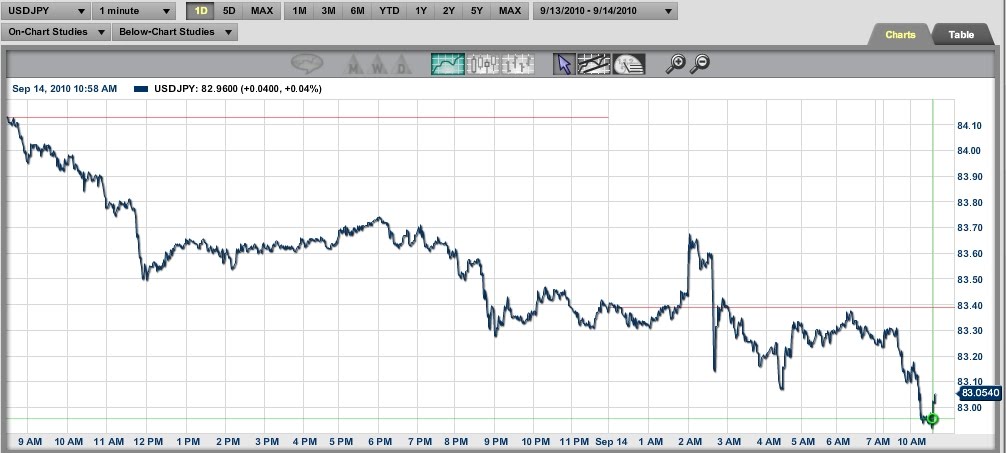
Yen Keeps Rising, Touches 82.94, 60 Year or All-Time High


Chart is live from INO tools (access free trial)

Please see previous post for table of prices.

Stumble Upon Toolbar

Further Currency Chaos Expected: Yen Rises to Fresh 15-Year High Overnight

In spite of all the rethoric coming out of the Bank of Japan, the inevitable happened: The Yen rose overnight to a fresh new 15-year high, hitting 83.10 around 4AM. Expect further currency moves.

Why is this so important? Currency moves reflect on stock prices. There is a very strong cdirect correlation.

24-hour chart on the Yen in US Dollars:


(please click to enlarge, chart is live from INO's tools)

If you wish to see the revert chart and the "high", just look at the Yen ETF (FXY, click to receive technical analysis and buy/sell alerts):


Note that there was a long term buy signal on May 6th.

Stumble Upon Toolbar

Monday, September 13, 2010

Bonds Lose Big, TLT Straddles Return +44% in 13 Days

Bonds have dropped considerably, TLT lost 7% since August 31, when we posted the straddles. Below is the current status of our straddles on TLT. +44% ROI, not bad for 13 days.


This is why we do straddles as opposed to try to predict market direction using all kinds of funny analyses.

Computed with our StraddlesCalc Tool

Stumble Upon Toolbar

IMF Says "Annus Horribilis", More Stimulus Needed to Fix Dire Labor Market

At a conference co-hosted by the IMF today, the entity says that the world's rich countries need to extend fiscal stimulus to "fix a dire" labor market that could threaten entire societies.

According to the IMF said more and more workers worldwide are unable to find jobs for longer periods, weakening social cohesion and raising risks of unrest and even undermining democracy.

Dominique Strauss-Kahn, IMF's Managing Director, said that "The labor market is in dire straits," adding that the Great Recession had left a "wasteland of joblessness." "We must acknowledge that the crisis will not be over until unemployment declines significantly," "growth and jobs the "most urgent problems."

European Commissioner for Employment and Social Affairs Laszlo Andor said 2010 had been an "annus horribilis" for unemployment. "If we fail to act ... 2011 may still turn out to be the annus horriblis for social cohesion."

Reuters: "The IMF said that extended fiscal stimulus was worth the additional debt if it helped cut long-term unemployment, which poses an even costlier burden on society as workers get discouraged, lose lifetime earnings or leave the labor market.

The IMF said that due to the deep crisis, it now backs schemes to extend unemployment benefits to help maintain demand and morale, and to give short-term incentives to companies to retain more workers but at reduced hours and wages".

Stumble Upon Toolbar

Lots of New Billions Here and There Needed By Banks: Who Wants to Own Banks That Can't Pay Dividends for 3 Years!

It turned out that DB Deutsche Bank AG needs $12.5B, not 'just' the $11B that was reported last week. Hello dillution.

The reason are "takeovers" and to meet stricter capital rules. Basel III reached a conclusion this weekend, and with it, banks will need to raise more money, a lot more money. Please see our post last Friday as to what this means (it won't be pleasant for the stock markets).

Bloomberg reports: "Regulators looking to rein in the sort of risk-taking that caused the last financial crisis reached a compromise in Switzerland yesterday that more than doubles capital requirements for the world’s banks while giving them as long as eight years to comply.
[Basel] will require lenders to have common equity equal to at least 7 percent of assets, weighted according to their risk, including a 2.5 percent buffer to withstand future stress. Banks that fail to meet the buffer would be unable to pay dividends, though not forced to raise cash.
The definitions of what counts as capital and how risk is assessed have also been tightened. Some banks, such as BAC and Citigroup Inc., will be restricted in how much cash they can return to shareholders and pay their employees in years to come. Others, like Deutsche Bank AG, have already announced plans to raise additional capital.

“These are big changes in capital requirements,” said James Wiener, the New York-based head of finance and risk practice at Oliver Wyman, a management-consulting firm. “There’s a long period of adjustment, which takes off some pressure. But still, who wants to own a bank that can’t pay dividends for three years?”

Stumble Upon Toolbar

Friday, September 10, 2010

Options on Financials ETFs: 1X vs 2X vs 3X

I have written about this in the past. Here is my study for next week, perhaps as early as Monday, if stocks drop.

As of 2:45PM today, these are the current values of the following financial ETF and their just ITM and OTM puts:

XLF $14.51

  • 14P $0.06/$0.07
  • 15P $0.56/$0.57

UYG $54.34
  • 53P $0.95/$0.98
  • 54P $1.34/$1.36
  • 55P $1.82/$1.85

FAS $21.39
  • 19P $0.17/$0.18
  • 20P $0.34/$0.35
  • 21P $0.66/$0.67
  • 22P $1.16/$1.17

Stumble Upon Toolbar

Banks and Financials Raising More Funds = Leading Down: Profit Up or Down With Straddles

With stocks about to potentially suffer major losses, and this being related to banks and financials woes, below are straddles for XLF, for October and December. XLF happens to be sitting at a perfect price equidistant from strike prices.

Computed with the free StraddlesCalc Tool, which shows the number of puts and calls for a given amount to spend, and the moves required for the position to become profitable.


Please do your own due diligence. This is not advice. Options are very dangerous and may cause 100% loss.

Stumble Upon Toolbar

Watch Out Below: Banks Raising Capital Means Stocks and Commodities Will Go Down Hard

A very interesting and plausible theory explains why stocks are being pumped and will come crashing hard. It's all in the enws today that Deutsche Bankhas gone down about 7% in Europe because it is raising some $11B in capital, thus causing dillution for shareholders. That's all fine and dandy. However, the real story may be that all banks will need to do the same. Yesterday it was reported that European banks need capital (see our post). Basel III is being mentioned for that.

In the U.S. the story is that it's the Volcker rule, which is forcing major banks to shut down their trading operations (JPM announced so, and all or most others will follow, story).

"The Volcker Rule empowered by the Dodd-Frank financial-overhaul law
effectively bans proprietary trading and principal transactions along with
private equity deal-making and other investing techniques that are used to
benefit "the house" -- read Wall Street banks".

Actually, these trading operations are not being shut down, they are being separated from the banks. Proprietary trading accounts for about 15% of banks' revenue. Moving this trading outside the banks per se will not solve any conflict of interest prblems. As Marketwatch's Kostigen points out:
"Good luck trying to figure out whether the bank front-runs client trades,
uses inside information to profit, or exploits some loophole in the law".

Anyway, it is happening. These new trading houses, which will be big, very big, will want to make lots of money. Bill Cara theorizes that the best way of doing that is by starting with stocks at low prices. Since they have the support of the major banks, who really control the market, stocks should be pushed lower.

Much lower, actually. Bill says:
Well now I’m telling you that these HB&B proprietary trading desks will
be looking to start at or closer to the bottom of the market cycle than the top
in order to make humungous profits for their investors who will be – you got it
– mostly Goldman Sachs & Co, JP Morgan et al, and friends and family. It's
also possible that HB&B sees a major collapse in equity and bond prices in
the next year and doesn't want to face the music in Congressional hearings,
noting that their prop trading desks had made gazillions as the market fell,
clipping their clients, including America's biggest pension funds, along the
way.

Forex and Currency Chaos

Furthering the case for this scenario is the fact that during the 2007/2008 crisis, the Euro was much stronger than it is now. We know at that time there was a huge flight to safety, which caused the US dollar to rise.

Euro chart (we track all currency ETFs live here):


Even gold suffered in that period:


When the USD rises, stocks, commodities drop.

Shall this play out, in the months ahead, watch out below.

Stumble Upon Toolbar

Business Comparison: USA vs Canada vs Brazil vs Chile

From the World Economic Forum come these economic development charts. We compare Brazil, Chile, Canada, and the U.S.

7 on the scale is best, 1 worst.

The U.S excels in several areas, including market size and innovation. Canada in health and primary education and institutions, infrastructure; Brazil also does well in both size and primary education; Chile excels in health, and institutions.


Please click to enlarge.

Stumble Upon Toolbar

Thursday, September 9, 2010

Roubini in Toronto, September 2010: Outlook Has Severely Deteriotated


The ubiquitous Nouriel Roubini was in Toronto yesterday.
BNN interviewed Dr. Doom. He says that the outlook has significantly deteriorated and that there aren't simply solutions. Liquidity solutions cannot solve problems.

Stumble Upon Toolbar

September 2010: Canadian Banks Are the Safest in the World

Canadian politicians are jumping in joy today. The World Economic Forum says that Canada's banking system is the safest in the world - for the third straight year.

However, Canada slipped a notch to number 10 on the list in terms of competition. The top ranked is Switzerland, 2nd is Sweden, third is Singapore, with the United States falling to fourth.

The U'S' slipping competitiveness is attributed to a build-up in U.S. macroeconomic imbalances, a weakening of the country's public and private institutions, as well as concerns about the state of its financial markets.

Top 100 in order of competitivess:

1.Switzerland
Sweden
Singapore
United States
Germany
Japan
Finland
Netherlands
Denmark
10. Canada
Hong Kong SAR
United Kingdom
Taiwan, China
Norway
France
Australia
Qatar
Austria
Belgium
20.Luxembourg
Saudi Arabia
Korea, Rep.
New Zealand
Israel
United Arab Emirates
Malaysia
China
Brunei Darussalam
Ireland
30.Chile
Iceland
Tunisia
Estonia
Oman
Kuwait
Czech Republic
Bahrain
Thailand
Poland
40. Cyprus
Puerto Rico
Spain
Barbados
Indonesia
Slovenia
Portugal
Lithuania
Italy
Montenegro
50. Malta
India
Hungary
Panama
South Africa
Mauritius
Costa Rica
Azerbaijan
Brazil
Vietnam
60. Slovak Republic
Turkey
Sri Lanka
Russian Federation
Uruguay
Jordan
Mexico
Romania
Colombia
Iran
70. Latvia
Bulgaria
Kazakhstan
Peru
Namibia
Morocco
Botswana
Croatia
Guatemala
Macedonia, FYR
80. Rwanda
Egypt
El Salvador
Greece
Trinidad and Tobago
Philippines
Algeria
Argentina
Albania
Ukraine
90. Gambia, The
Honduras
Lebanon
Georgia
Moldova
Jamaica
Serbia
Syria
Armenia
Mongolia
100. Libya

Stumble Upon Toolbar

Apple Finally Clues In: Allows Adobe's Flash Player

Perhas we should give credit to Samsung for this. Samsung released its tablet PC, as reported here, and it allows Flash player, unlike Apple used to. Or it could also be in conjunction with the fact that Apple also lost the number one spot in cell phone to to Google's Android.

They milked the iPhone and the iPad all they could, now Apple's arrogance has taken a hit: it has now decided to allow Flash player for development and in its store.

The Wall Street Jounal says: "Apple Inc.'s less-than-forthcoming press release about relaxing restrictions put on app developers may be an indication that it's retreating in its battle against Adobe Systems' flash technology, used to design Internet sites. According to Apple's release, one of the sections relaxed was 3.3.1, which had required developers to use Apple-approved programming languages".

Adobe, ADBE, jumped +11%. GOOG is up +1.8%.

Stumble Upon Toolbar

Canadian Dollar Jumps With Hike in Interest Rates: Profit Either Way With Options


With the hike of 0.25% in ientrest rates this week by the Bank of Canada the Canadian dollar has jumped about 2%.

Here are straddles for September, October and December for FXC, computed with StraddlesCalc Tool


Note: You may receive technical analysis and alerts of these stocks, sent automatically to you, by entering the symbols in the Technical Trend Analysis Tool, (powered by INO).

Please do your own due diligence. This is not advice. Options are very dangerous and may cause 100% loss.

Stumble Upon Toolbar

U.S. Economic Growth Revised Down Again: Fed To Keep Rates At 0.25% Until Mid 2011; Unemployment High Until Late 2011

The latest in the latest Blue Chip Economic Indicators report was just released. Projected U.S. economic growth for the rest of this year as well as next year was revised down for a third month in a row

The report says that weaker outlook stems from lower expectations for consumer spending, business investment and private construction.

"Growth in the current quarter now is expected to be little better than the disappointingly soft advance registered last quarter,"

"For all of 2010, real GDP now is forecast to increase 2.7 percent on a year-to-year basis, 0.2 of a percentage point less than a month ago and 0.6 of a point less than predicted in June,"

"Given the depth of the recession, a forecast of roughly trend growth this year and next amounts to a very disappointing pace of recovery, with little progress expected to be made in lowering the unemployment rate,"

It adds that it expects U.S. unemployment rate will end this year at 9.6% and fall only to 9% by the end of 2011.

On the somewhat positive side (relatively speaking), it forecast that after averaging 554,000 new housing units in 2009, starts this year will rise to 600,000 and to 760,000 units in 2011.

"Although residential investment appears destined to subtract from GDP in the second half of this year, double digit growth is expected by early 2011, with rates of growth over 30 percent by the second half,"

It also expects short-term interest rates to remain very low before starting to rise next summer. The Federal Reserve likely will keep the federal funds rate at its current range of zero to 0.25 percent through mid-2011, finally raising it to 0.75 percent by the end of 2011.

Stumble Upon Toolbar

Castro: Cuban Model No Longer Works, Not for Cuba, Not For the World

Reuters reports that Fidel Castro says Cuba's economic model no longer works.

Jeffrey Goldberg, writer for the Atlantic Monthly magazine, interviewed Castrom, after being invited to Havana to discuss his recent article about the likelihood of conflict between Israel and Iran and the prospects of nuclear war.

Goldberg asked Castro if Cuba's model (Soviet-style communism) was still worth exporting to other countries. Castro replied:

"The Cuban model doesn't even work for us anymore."

Castro also criticized Iranian President Mahmoud Ahmadinejad for "anti-Semitism and denying the Holocaust".

Castro has become an anti-nuclear weapon crusader, "he fears that if the United States and Israel try to enforce international sanctions against Iran for its nuclear activities, nuclear war will break out".

"Castro also criticized his own actions during the 1962 Cuban Missile Crisis when he urged the Soviet Union to launch nuclear weapons against the United States, telling Goldberg "it wasn't worth it at all."

They went to National Aquarium in Havana with a local Jewish leader Adela Dworin, "who Castro kissed in front of the cameras in a possible message to Iranian leaders".

Stumble Upon Toolbar

ECB: German Banks Are Undercapitalized

Juergen Stark, chief economist of the European Central Bank, said at a meeting with the head of Unions Parliamentary Group in Berlin, that German banks are undercapitalized.

"He was referring largely to savings banks and regional banks (Sparkassen und Landesbanken). Accordingly, called for privatization of the German savings banks, based on the successful Spanish model. The ECB declined to comment.

Jürgen Stark’s comments feed doubts about the local banking system.This is even more surprising given the positive results for the regional banks in the stress test of the EU in July, in which the ECNB were heavily involved".

"Germany should make concessions regarding Basel III. US is betting that German banking system won't be able to stay in current form after Basel III. Fears slight inflation trend in US from Obama's stimulus program" (FxStreet)

Stumble Upon Toolbar

The Latest Unemployment Claims: 9 Nine States Did Not Report

Another example of sheer misinformation and spin. The headlines report that unemployment claims are better than expected. Well, they may be, however...

"For the latest reporting week, nine states didn’t file claims data to the Labor Department in Washington because of the federal holiday earlier this week, a Labor Department official told reporters. As a result, California and Virginia estimated their figures and the U.S. government estimated the other seven, the official said".

So are they?

Claims "dropped" by 27,000 to 451,000 in the week ended Sept. 4.

Also, the "total number of people receiving unemployment insurance was little changed, while those getting extended payments rose" (Bloomberg)

It is amazing that anyone believes and follows these numbers.

Stumble Upon Toolbar

Financial TV

// adding Google analytics